

About the R&D Division
Research Division Overview
Generation of ultra-intense laser fields (>1019 W/cm2) using high-power lasers exceeding tens of terawatts (1012 W)
Exploring relativistic light–matter interactions using ultra-intense laser fields
- Relativistic laser–plasma interactions
- Laboratory Astrophysics
- Properties of matter under extreme conditions
- Strong Field Quantum Electrodynamics (QED)
- Development and applications of ultrafast secondary sources (protons, ions, electrons, and high-energy photons)
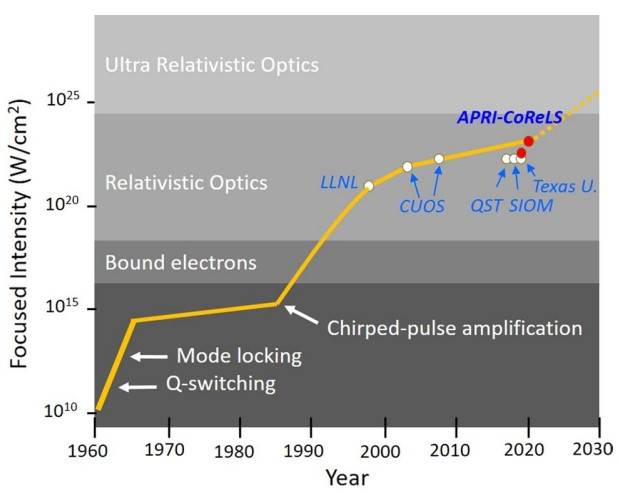 Trends in laser intensity development and interaction regimes as a function of laser intensity
Development of ultra-high-power lasers and generation of ultra-intense laser fields
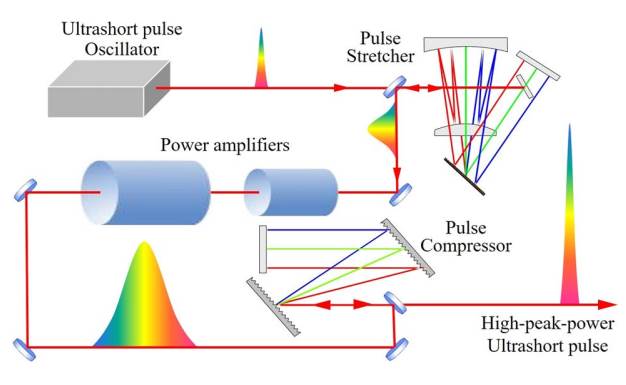
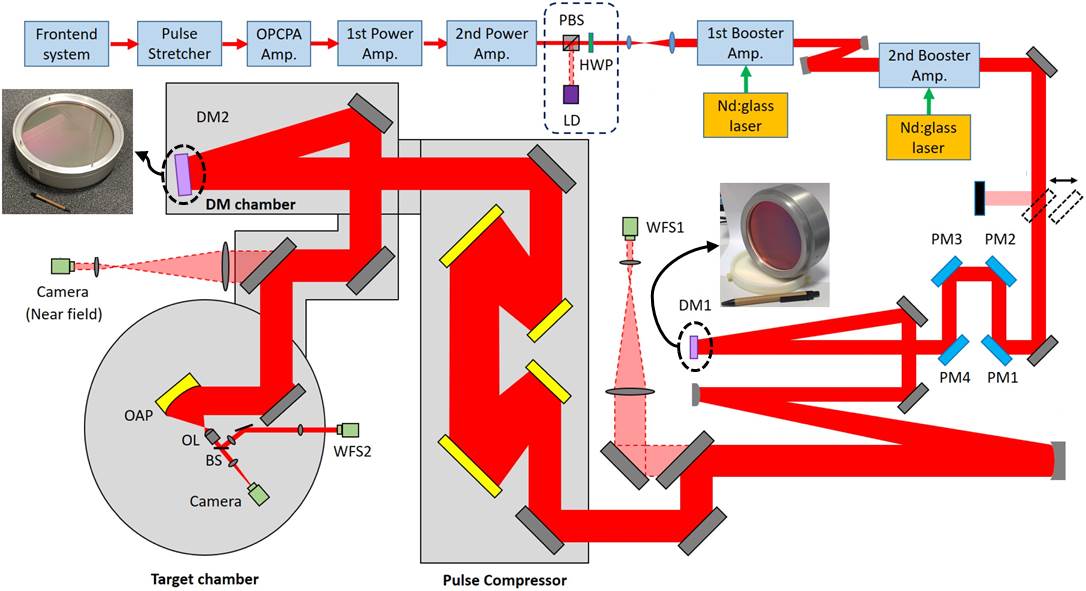
Development of high-power laser systems based on Chirped Pulse Amplification (CPA)
- Development of petawatt-class (1015 W) ultrafast laser systems
- Development of AI-based technologies for laser performance stabilization and automated operation
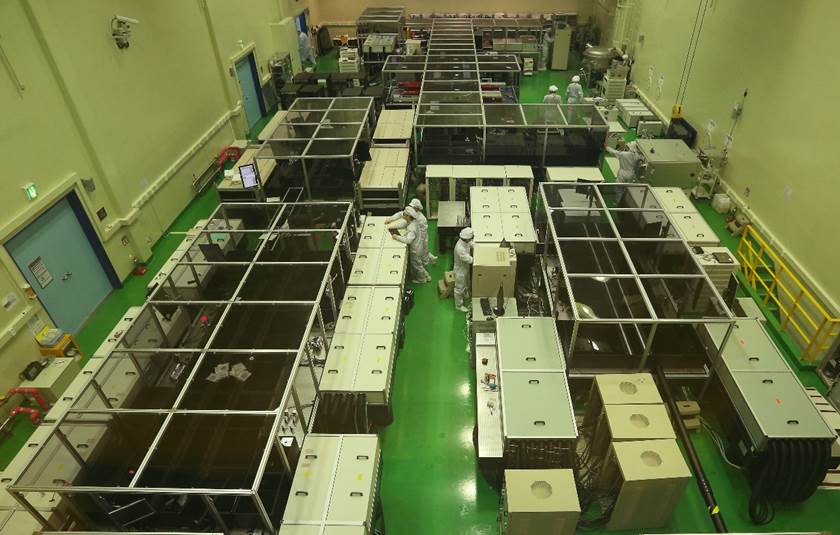 4 PW Ultra-intense laser
(82 J, 20 fs, 0.1 Hz)
4 PW Ultra-intense laser
(82 J, 20 fs, 0.1 Hz)
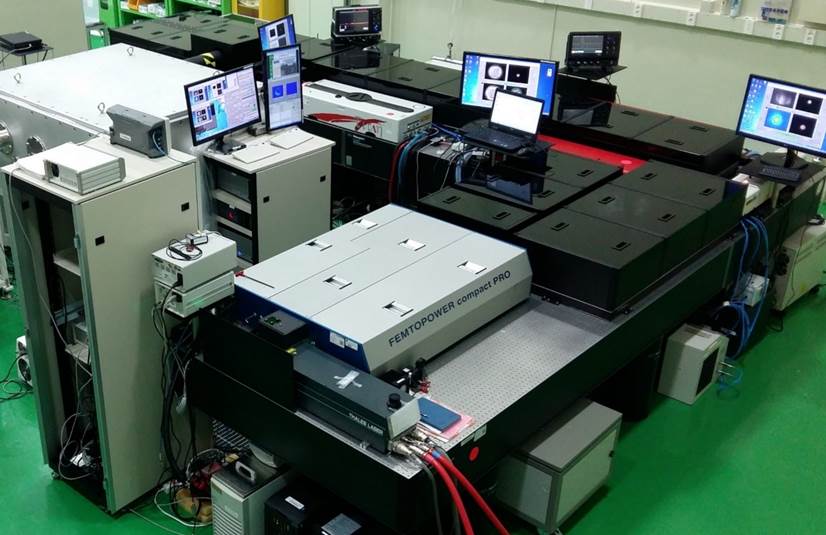 150 TW Ultra-intense laser
(4 J, 25 fs, 5 Hz)
150 TW Ultra-intense laser
(4 J, 25 fs, 5 Hz)
Development of temporal contrast control and enhancement techniques for ultra-intense laser pulses
- Development of Optical Parametric Chirped Pulse Amplification (OPCPA)
- Development of cross-polarized wave (XPW) generation
- Development of plasma mirror technologies
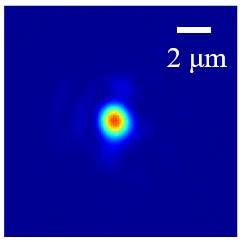
Generation of ultra-intense laser fields using adaptive optics
- Wavefront correction and tight focusing for ultra-intense laser field generation
- Diagnostics and mitigation of spatio-temporal coupling in high-power laser systems
Two-dimensional focal spot image
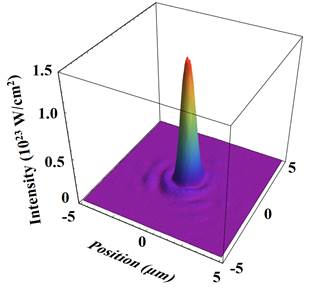 Three-dimensional focal spot image
Three-dimensional focal spot image
Study of interactions between ultra-intense lasers and matter
Exploration of novel physical phenomena under extreme conditions created by ultra-intense laser–matter interactions
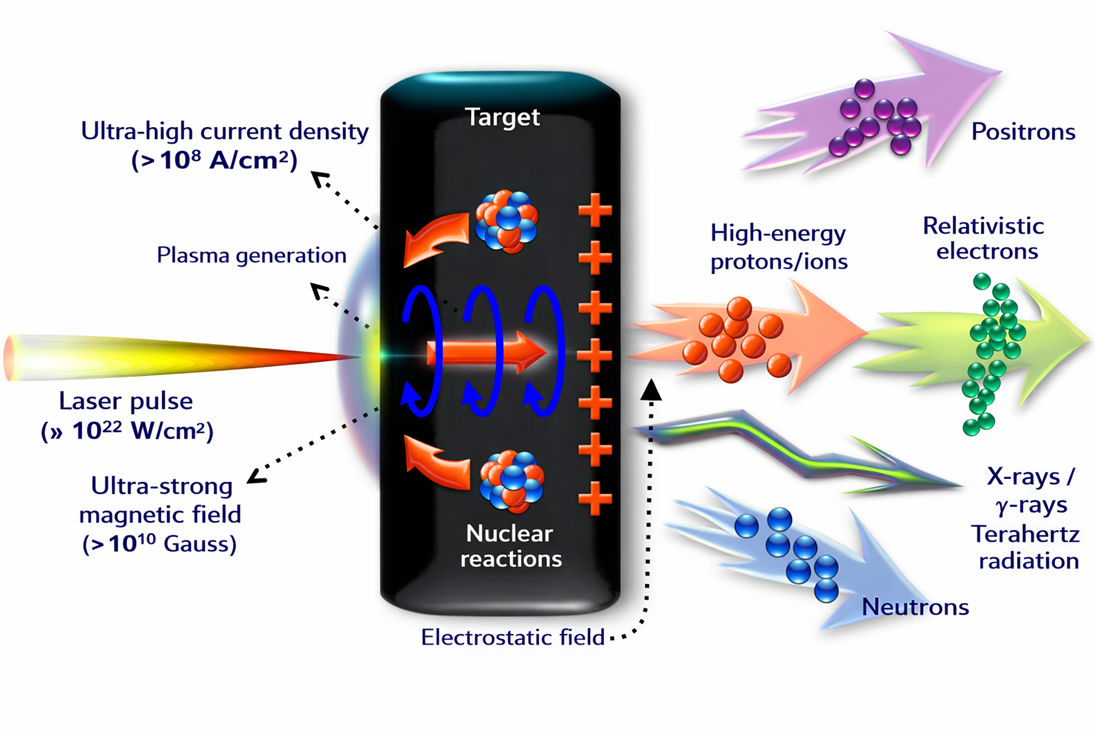
Ultra-intense laser–matter interactions
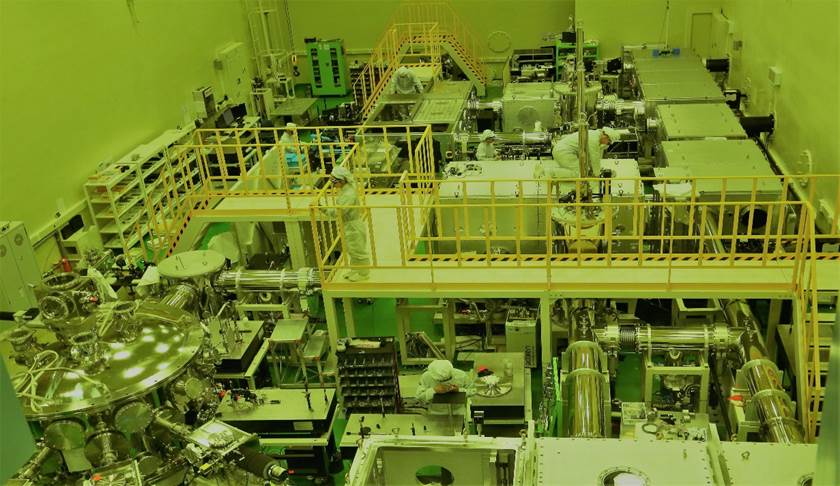 PW Laser-Plasma Laboratory
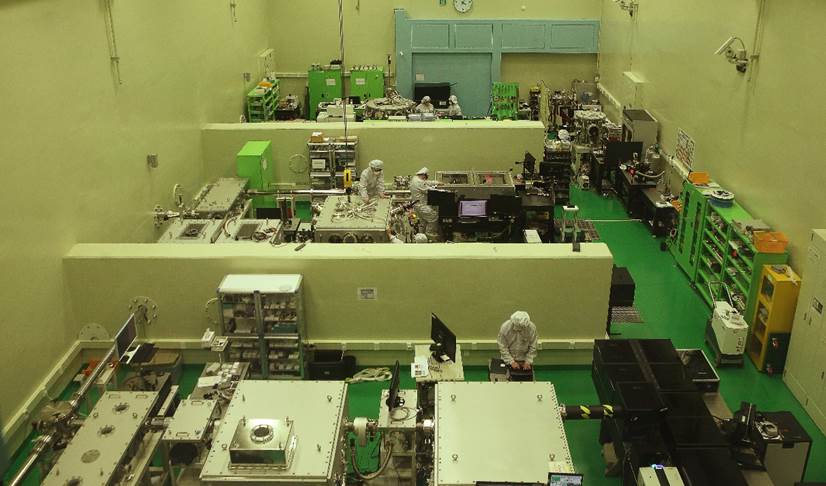 150 TW Laser-Plasma Laboratory
Study of interactions between ultra-intense lasers and low-density plasmas
- Generation and stabilization of ~10 GeV electron beams
- Research in strong-field quantum electrodynamics (QED)
- Gamma-ray source development via nonlinear Compton scattering
- Electron–positron pair production via the nonlinear Breit–Wheeler process
- Characterization and applications of high-energy radiation (betatron and bremsstrahlung)
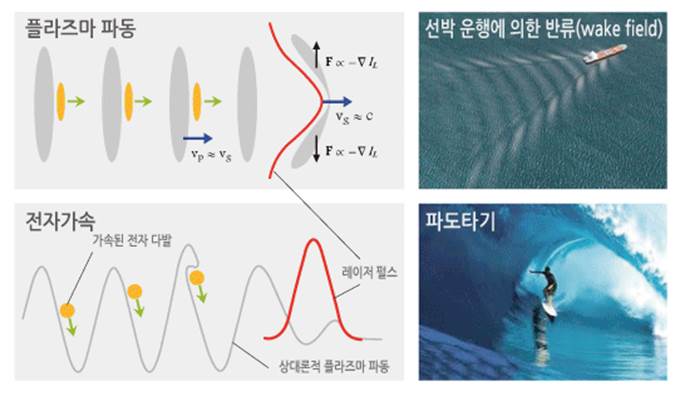 High-energy electron beam generation via plasma wakefield acceleration

>

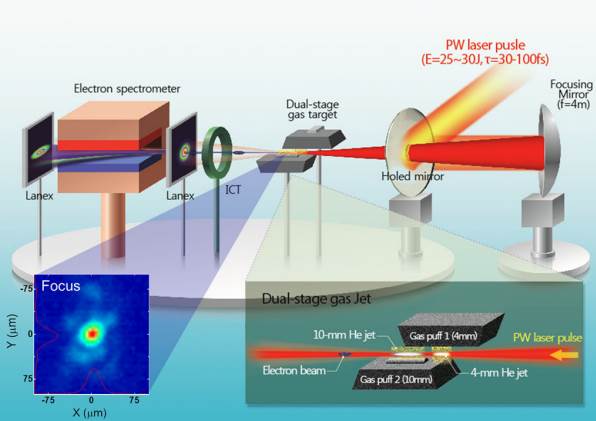
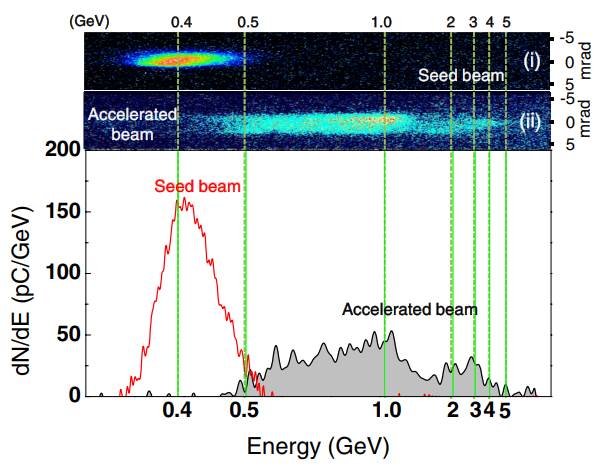
High-energy electron beam generation experiments
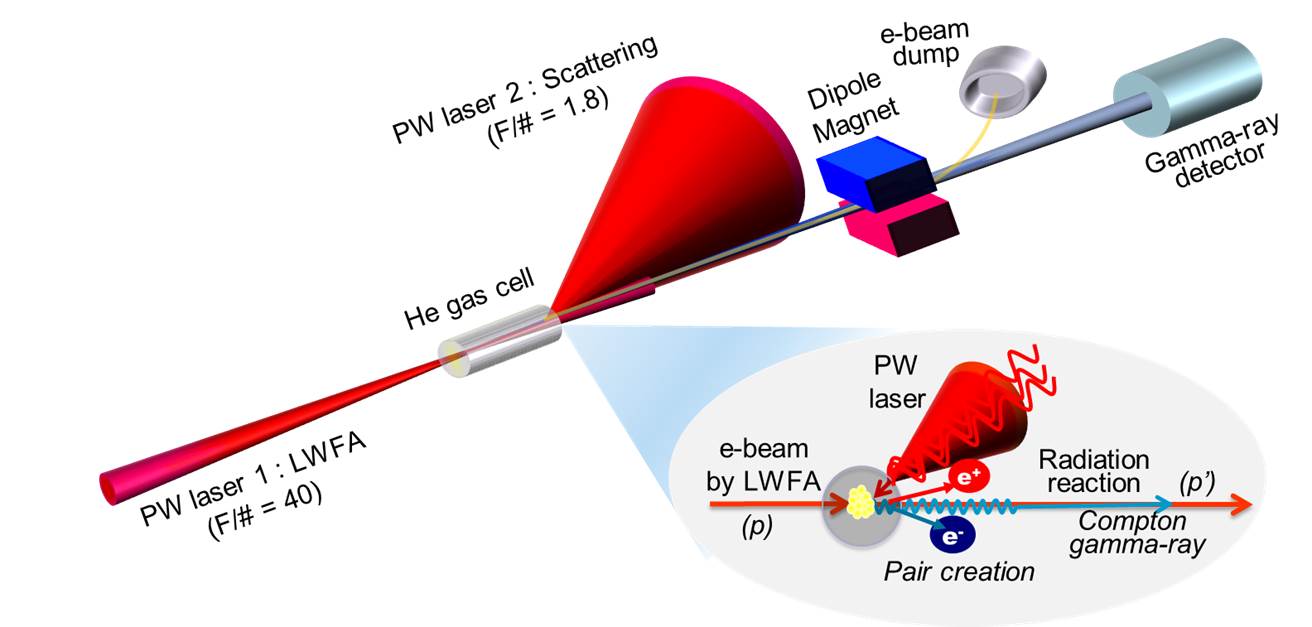
Study of interactions between ultra-intense lasers and high-density plasmas
- Generation of quasi-monoenergetic ~200 MeV proton/ion beams
- Biological applications of proton beams
- Development of diagnostic systems for electromagnetic radiation, electrons, and ions
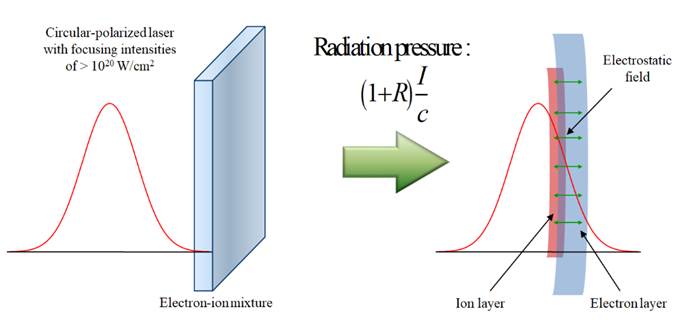 Radiation Pressure Acceleration
(RPA)
Radiation Pressure Acceleration
(RPA)
 High-energy proton and ion generation via RPA
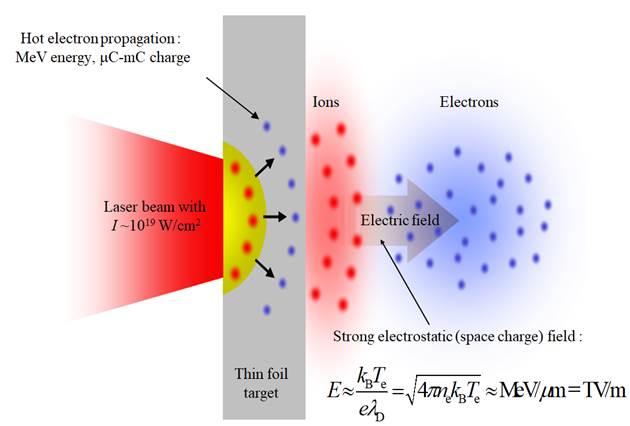 Target Normal Sheath Acceleration (TNSA)
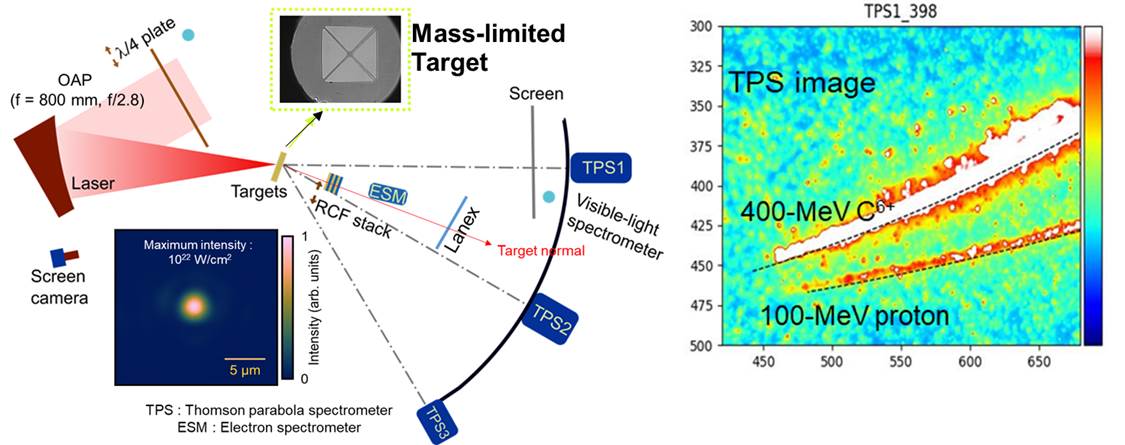 High-energy proton and ion generation via TNSA
Theoretical research on ultra-intense laser–matter interactions
- Understanding energy transfer mechanisms between ultra-intense electromagnetic fields and plasmas
- Formation and stability of extreme environments driven by relativistic nonlinearities
- Novel particle acceleration mechanisms based on relativistic laser–plasma interactions
- Development of particle-in-cell (PIC) simulation codes
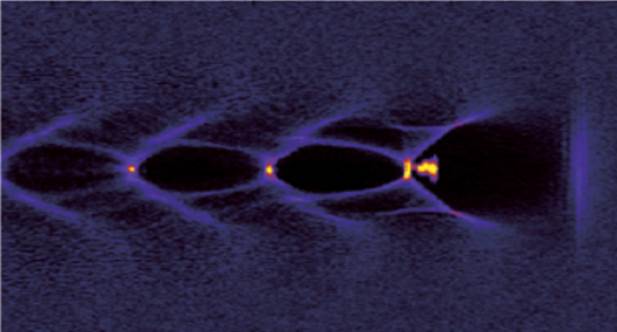 Simulation of electron acceleration via laser-driven plasma waves
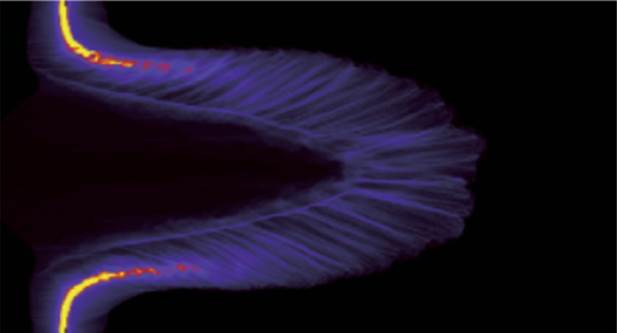 Simulation of proton acceleration via laser radiation pressure